
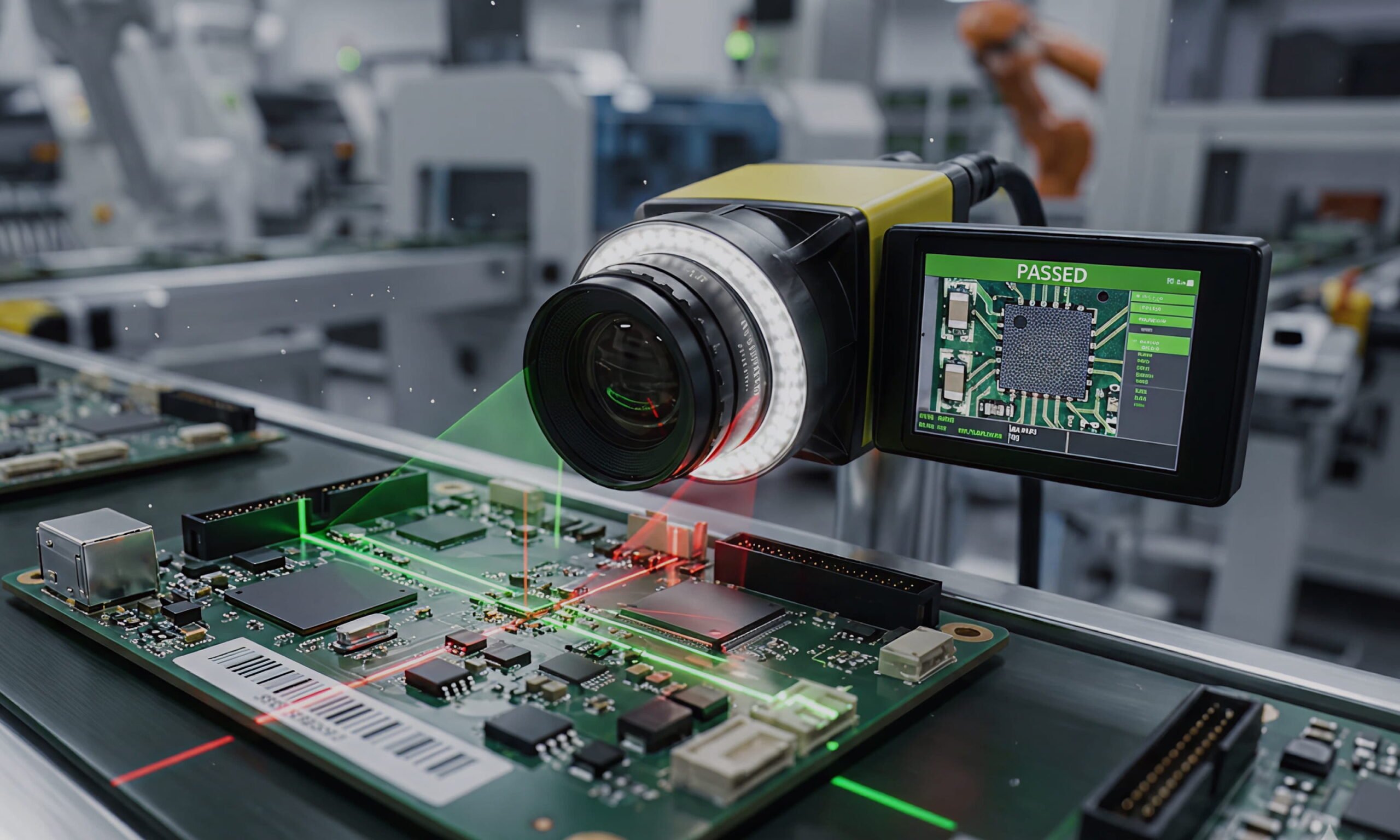
The business case for shop floor monitoring used to hinge on sensor procurement, PLC integration, and months of commissioning. For most mid-market manufacturers, that case was marginal: high upfront cost, long time-to-value, and significant IT involvement to integrate with production systems. The case for AI camera production monitoring using cameras already installed on the floor is structurally different, because the largest cost, the infrastructure, is already sunk.
This guide covers setup requirements, accuracy expectations, and ROI benchmarks for shop floor monitoring deployments built on existing camera infrastructure.
What does a camera-based shop floor monitoring system actually track?
A camera-based monitoring system extracts production intelligence from video feeds using AI inference at the edge. On a standard manufacturing floor, a properly positioned camera covering a machine station can track machine running state, cycle completion, operator presence, and process step compliance.
At the line level, camera coverage across a production line can track WIP accumulation between stations, identify which station is the constraint at any given moment, and measure takt adherence without manual observation.
At the plant level, aggregating camera data from all lines gives a plant manager real-time visibility into OEE by line, shift, and product type, without waiting for a shift-end data entry process.
Setup requirements: what your existing cameras need to support
Not all security cameras meet monitoring requirements without adjustment. Before deploying, assess three variables:
Positioning relative to work areas. Monitoring accuracy depends on camera view of the machine’s working zone, not the surrounding aisle. A camera covering a 15-metre aisle view is not useful for monitoring a specific press station. Repositioning may be needed for 30-40% of cameras.
Image quality and frame rate. 1080p resolution and 15fps or higher are the functional minimums. Most cameras installed after 2018 meet these specifications. Cameras below these thresholds produce reliable state monitoring but lose accuracy on process compliance checks.
Edge processing access. AI inference runs on edge devices placed on the camera network segment. These require power, rack space, and network access to the camera feeds. In most plants, the NVR room or server closet nearest the camera concentrations is the correct installation point.
Accuracy benchmarks: what to expect from camera-based monitoring
Based on deployments across manufacturing environments:
Machine state classification (running/stopped/transition) achieves 94-97% accuracy after calibration, with false-positive rates below 2% in stable lighting conditions. Accuracy drops to 88-92% in environments with highly variable lighting, such as outdoor loading areas or plants with skylights that change dramatically through the day.
Cycle count accuracy against manual observation benchmarks at 96-99% for discrete manufacturing (press, injection mould, assembly) and 90-95% for continuous or semi-continuous processes where cycle boundaries are less visually distinct.
Process compliance checks (was a label applied, was a fastener inserted, was the component orientation correct) achieve 92-96% accuracy for binary checks under standard conditions.
ROI benchmarks from camera-based monitoring deployments
ROI from production monitoring comes from three categories of value:
OEE improvement. In deployments where monitoring replaced no previous system, OEE improvements of 4-8 percentage points in the first six months are typical. A 4-point OEE improvement on a line running 100 units per hour at an average margin of Rs 500 per unit generates Rs 4,800 in recovered margin per 24-hour day.
Reduced quality escape investigation time. When a quality escape occurs, the investigation requires tracing the production event to a specific time, machine, and operator sequence. Manual investigation on a floor without monitoring takes 4-8 hours on average. Camera monitoring with timestamped event logs reduces this to 20-40 minutes.
Changeover time reduction. Camera-based monitoring identifies changeover sequence deviations and measures changeover duration automatically. Plants that use this data to run SMED exercises achieve 15-25% changeover time reductions within 90 days.
How Nagare runs on existing infrastructure
Nagare connects to existing CCTV feeds through standard RTSP protocols, adding an operational intelligence layer without disrupting security recording. The platform runs edge inference on Jidoka hardware that installs in the NVR room and surfaces production dashboards, machine-level OEE, and process compliance alerts through a browser-based interface accessible to supervisors on the floor and managers in the office.
